PRODUCT 01 · LEGEND OF THE BLACK SKIES · FOR SCI-FI ADVENTURE GAMERS → PRODUCT 02 · PLOTWARDEN · FOR ENGINEERING ORGS →
COGNICLUSTER LLC · ONE YARD · ONE BUILDER · HEADCOUNT: 1

A space game that never slows down.
And the orchestrator that builds it.

CogniCluster is Jeff Sylvan's public engineering lab: one Staff/Principal engineer building two systems in public. The first is a persistent multiplayer space game engineered for ten-thousand-player battles; the second is the durable agent orchestrator that keeps its development moving while specs change under it.

Product 01 · Legend of the Black Skies

For sci-fi adventure gamers

Your ship. Your crew. One galaxy that never pauses, and never slows down.

Every captain is the hero of their own story. In Legend of the Black Skies, ten thousand of those stories can collide in the same stretch of sky, at full speed. Yours might begin with a secondhand ship and a license fresh off a station clerk's desk, or somewhere far stranger.

You're a swashbuckling adventurer with a crew that depends on you. Take a contract off the station board, run a blockade through contested space, and limp home with a hold full of salvage while your chief grumbles about what you did to her engines. Your crew are people, each with short-term goals and life goals of their own, and helping them get there unlocks real rewards. Their unique abilities are yours to call on, and morale is the throttle: keep it high and they work at full speed; let it slide, and everything they do for you slows down.

You control the pacing through your loadout, with a feel Gloomhaven players will recognize: standard play stays smooth, but in a crisis every decision carries a payoff and a risk. The galaxy is alive around you: thousands of persistent NPCs fly the same ships by the same rules, and when you change the plot, human game masters decide how the world answers. The full story of how it plays lives on the game's own page.

Then there's the idea the whole design is built around. Every mechanic in Black Skies was shaped from day one so that fleets can converge at full speed, applying lessons from teams that operate at planetary scale: Discord, Google, Uber, Netflix. No time dilation by design. No molasses, no fight slowed to a crawl because the server is busy. The goal is simple: the biggest battle in the galaxy should play exactly like your first one, and if your shot misses in the chaos, it's because the target dodged or a wreck drifted into the lane, never because a server hiccuped. Curious how that's even possible? The full technical story is an eight-part engineering series at jeffrey.blog.

Start solo. Fall in with a crew of captains. End up in the battles they name eras after.

BACKEND · HARDENING, EXPANDING TEST COVERAGE UNITY CLIENT · EARLY DEVELOPMENT

HOW IT PLAYS: A SHIP MADE OF OWNED CARDS, A HAND THAT PAYS THROUGH CAPACITORS.
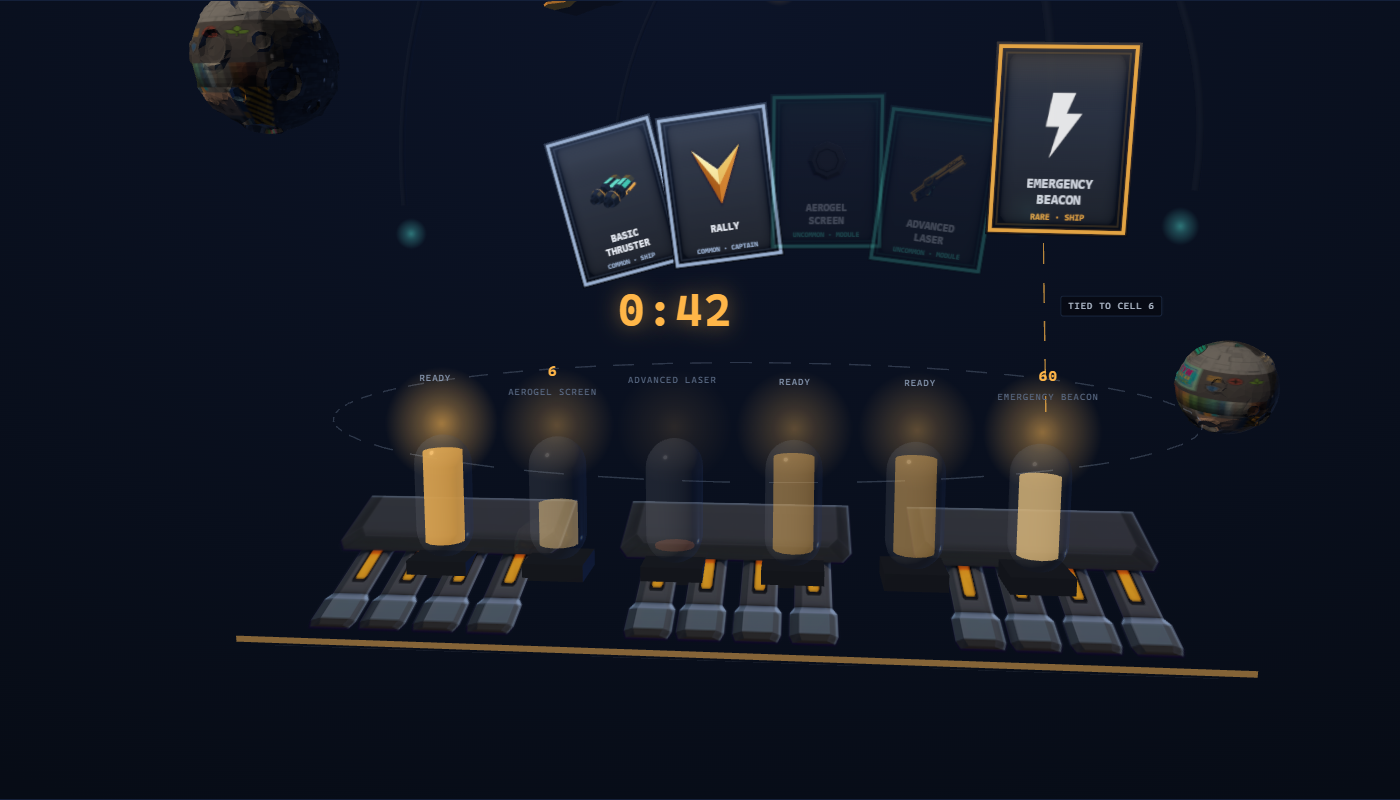
A still from the drydock diorama: a fanned hand of five rarity-framed cards above six capacitor cells, the big play counting down THE DRYDOCK · A GUIDED TOUR IN SIX CHAPTERS Enter the drydock: see how it plays → THE SHIP · THE CREW · THE HAND · ANY BRAIN · THE MISSIONS · PERSONAL STORIES
DESIGN TARGET · 10,000 CONCURRENT CAPTAINS · ONE BATTLE SPACE
TICK · 2 Hz · 2 Hz · 2 Hz
TIME DILATION · NONE. THE FIGHT DOES NOT SLOW DOWN.

Black Skies is in the shipyard. The full-speed promise gets proven in public trials before launch. Follow the build → · Engineers: how it works →

From the designer who shipped Alteil, a live tactical card game with tens of thousands of players, playing card games since Revised-era Magic.

Product 02 · Plotwarden

For product orgs running agentic workflows at scale

Durable orchestration for parallel development.

AI automation is everywhere now, and used well it genuinely multiplies what a team can ship. But ubiquitous is not the same as complete. The current generation of agentic tooling still has gaps, and Plotwarden, CogniCluster's orchestrator of ambient agents, is built to close one of the most expensive ones.

Agentic workflows shine in constrained spaces: a well-specified task, a stable spec, a bounded codebase, the right context, skills, and MCP servers, and oversight watching the run. Hand an agent that, and it comes back with credible work. Real product environments are not constrained. They are complex systems with many moving parts, where specs, features, and code all change constantly and at once. A workflow that was correct when it started quietly stops being correct while it runs, hallucinations slip in and cascade through everything built on top of them, and today a human closes that gap by hand, re-reading and re-planning between every session.

Plotwarden closes it continuously. It consumes changes wherever your specs actually live, GitHub issues, wiki edits, and the codebase and flows themselves, and maintains two living maps: the authoritative spec and the current state of your system, linked so it knows exactly how they relate. When the two drift, it reconciles, and this is the part built for the real world: it reconciles changes in flight, re-planning running work instead of restarting it. Work that a change made stale isn't an error, it's a superseded order: finish what survived, recall what didn't, salvage the partial. And when a change contradicts the spec or trips a red flag, it doesn't guess. The work blocks, the conflict surfaces on a review site where your team talks it through, and the resolution pipes straight back into the running project as ratified truth. Humans set direction and adjudicate genuine conflicts; everything else runs ambient. Minimal human-in-the-loop by design, not by neglect. The name is literal: in a ship's operations room, the plot is the authoritative picture of where everything is, kept true as every new report flows in. Keeping the plot is the job.

What exists today is stated plainly. v0.1.5 is a working scaffold: Temporal workflows, a Postgres event log, Docker-isolated workers, and tool proxies that turn ordinary commands into manager-reviewable evidence. 37 passing tests, 14 published invariants, one rule underneath: workers produce evidence, never authority. APIs are unstable and the spec is public so you can argue with it while it's still cheap to change.

EARLY CONCEPT · PROTOTYPING
WORK IN FLIGHT
GATE · EVIDENCE REQUIRED
STALE EPOCH · HELD FOR SALVAGE
The drydock board

Where everything actually stands.

BLACK SKIES · BACKEND
KEELFRAMESPLATINGTRIALSLAUNCH
hardening + expanding test coverage
BLACK SKIES · UNITY CLIENT
KEELFRAMESPLATINGTRIALSLAUNCH
early development
PLOTWARDEN
KEELFRAMESPLATINGTRIALSLAUNCH
early concept · prototyping

AS OF JULY 2026 · Positions are coarse on purpose: no percentages, no promised dates. When something moves, the board moves.

The shop

One engineer, operating at team scale.

There is no pretend team here. CogniCluster is Jeff Sylvan, a Staff/Principal-level distributed systems engineer with twenty-plus years across fintech, marketplaces, SaaS, ecommerce, and game infrastructure, working with an orchestrated fleet of AI coding and research agents. Everything above was designed, built, and operated by one person, in public, with the evidence published.

The founder is currently available for full-time Staff/Principal work, distributed systems, platform, and AI infrastructure. Boston area or remote (July 2026).